Investment-Grade Coins
Chart below outlines a $10K initial purchase in 2010 of Gold Eagle Proof 70 coins vs Bullion.*

In 1985, Congress passed the Bullion Coin Act, which led the U.S. Mint to launch its first major project—the Gold American Eagle 1 oz coin, crafted entirely from gold sourced within the United States. Each year, the U.S. Treasury issues two versions of this coin: a standard "Mint State" edition intended for bullion trading and circulation, and a premium "Proof" edition designed for serious investors focused on medium- and long-term wealth preservation.
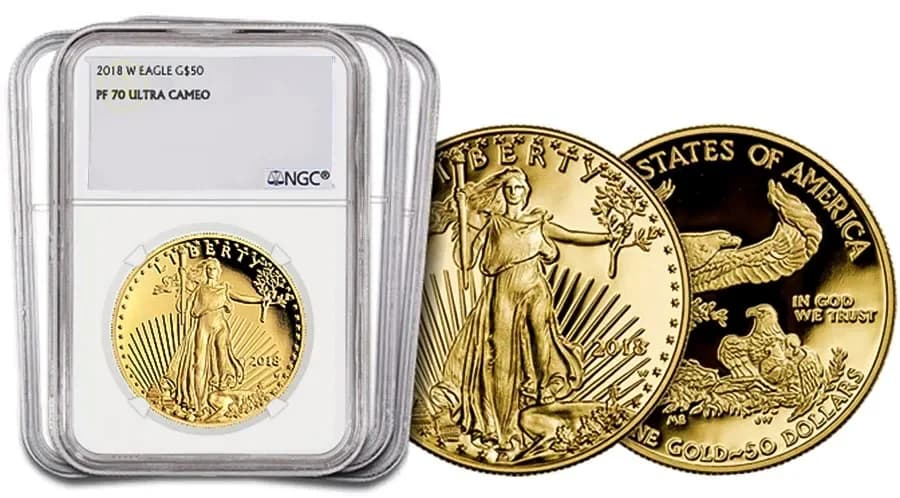
Over time, specialized coin groups were introduced to classify and distinguish American Gold Eagle Proof 70 coins. These groups reflect broader economic and social trends that have shaped the market across different periods.
Diversification is a core investment philosophy designed to balance and reduce overall risk. Assets are typically divided into categories, or "classes." When two assets react in the same way to shifts in the economy, they are considered "correlated." When they move differently under the same conditions, they are "non-correlated." For example, stocks and precious metals fall into different asset classes, since they generally don't rise and fall together. This is why many investors include both in their portfolios—and it's one of the key reasons people choose gold.
What many investors overlook, however, is that the same diversification strategy can be applied within the gold market itself. At Citadel Gold, we emphasize balancing a portfolio across the two main categories of precious metals: bullion and Certified Investment Grade Coins.
The Power of Balance
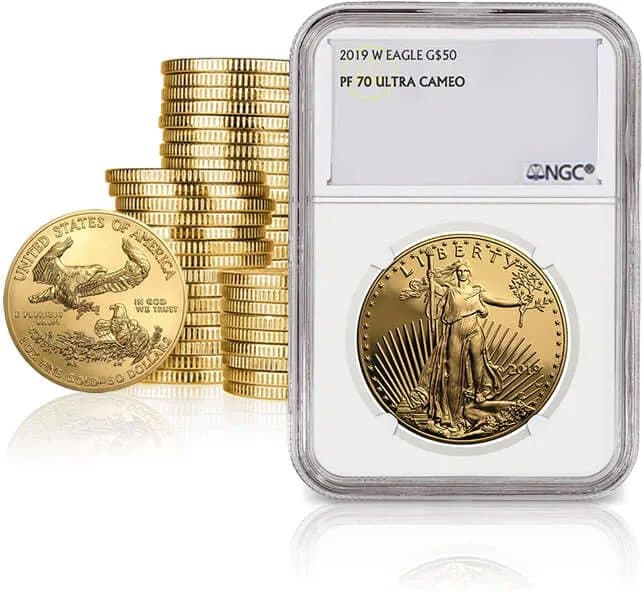
At Citadel Gold, we believe that true diversification within precious metals means holding both bullion and Investment Grade Coins. Bullion delivers direct exposure to gold's market value, while Certified Investment Grade Coins add stability, reduce volatility, and protect against economic uncertainty.
Together, they create a more resilient precious metals portfolio—one positioned not only to withstand market swings but also to support long-term financial security and growth.
Take the Portfolio Quiz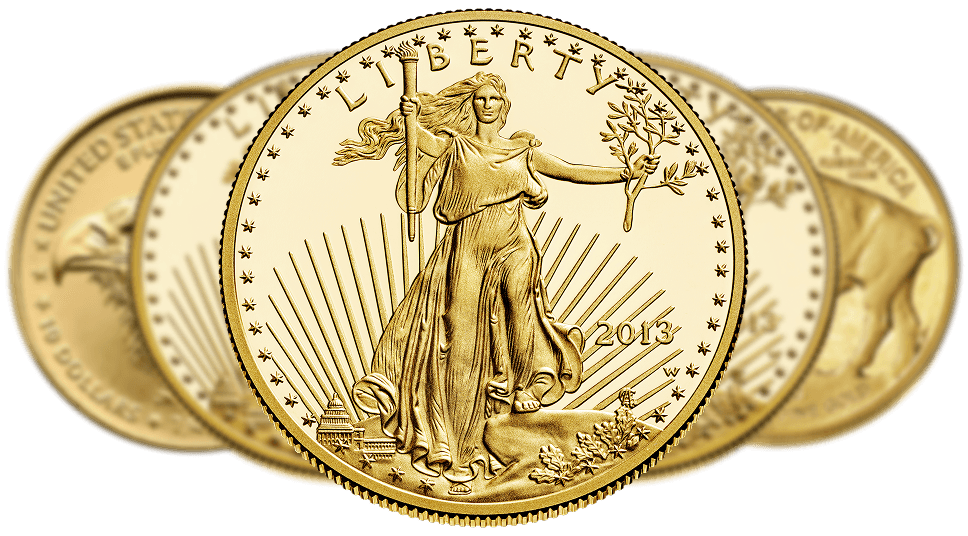
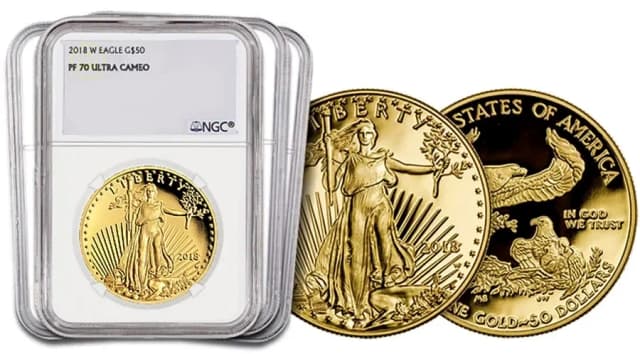
Gold Eagle Proofs that have been independently certified in flawless, "museum-quality" condition are classified as Investment Grade Coins. Their rarity and premium standing place them in a different category from standard bullion coins.
Unlike bullion, their value is not directly tied to daily fluctuations in the gold "spot price." Because of consistently rising demand and a limited supply, these coins tend to hold their value more steadily over time. In fact, the performance of many Investment Grade Coins has historically outpaced gold bullion, making them a strong choice for investors seeking long-term protection and growth.
For this reason, Citadel Gold recommends Investment Grade Coins as a reliable store of wealth—a safeguard against downturns in the bullion market and broader economic volatility.
The Ultimate Gold Eagle Investment
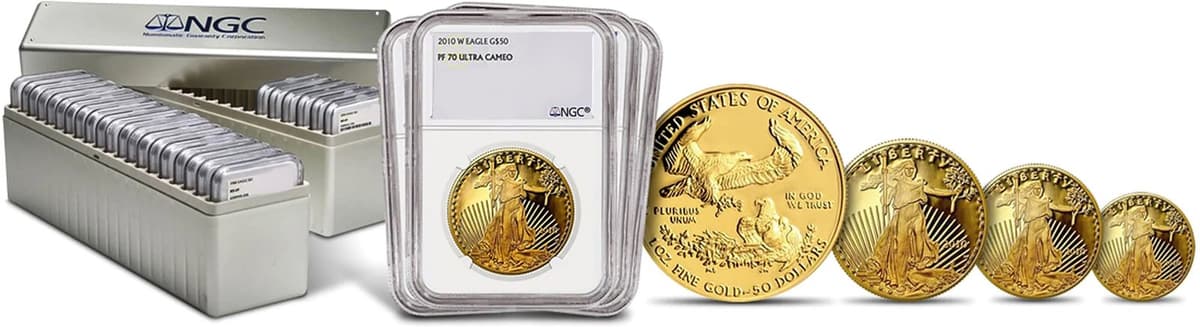
This exclusive collection is designed for discerning investors who understand that a complete Date Run of Gold American Eagle Proof 70 coins represents a rare and unmatched opportunity in tangible asset investing. Regarded as the cornerstone of Gold Eagle portfolios, this set stands as the pinnacle achievement for investors who recognize that in coin investing, the entire collection carries greater value than the sum of its individual parts.
The Gold American Eagle Date Run features one coin from each denomination for every year of mintage. This includes the 1 oz coin from 1986, both the 1 oz and 1/2 oz coins from 1987, and the full range of denominations—1/10 oz, 1/4 oz, 1/2 oz, and 1 oz—from 1988 through the present (with the exception of 2009, when Proof Gold Eagles were not minted). This makes it the definitive Gold American Eagle collection.
For investors seeking both protection and long-term growth, this portfolio offers stability beyond the volatility of the stock market and insulation from the uncertainties of the bullion commodities market.
Learn About the Date Run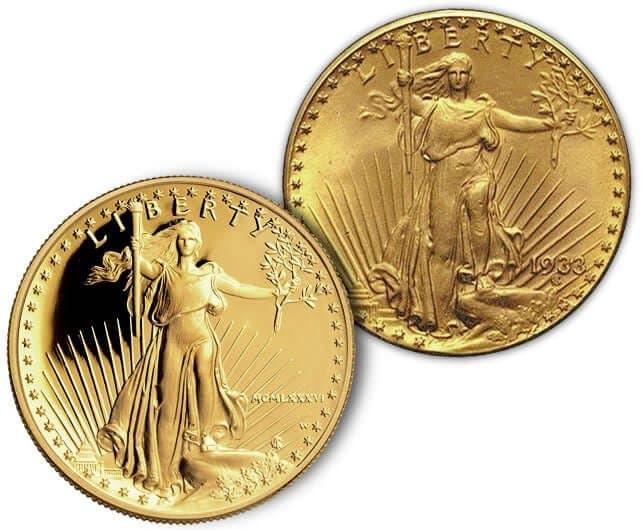
Beyond pricing and market behavior, the production process sets bullion and Proof coins apart. Proof coin production is an intricate, labor-intensive process that requires precision and expert oversight. Polished blanks are carefully hand-fed into a coin press, where each blank is struck multiple times. This repeated striking creates the sharp, detailed imagery and flawless high-sheen background that distinguish Proof coins, especially those earning the highest grades.
Grading and Value
In December 1985, during his second term, President Ronald Reagan signed the Gold Bullion Act of 1985, officially authorizing the creation of the Gold American Eagle. The U.S. Mint released the first coins the following year, marking the beginning of one of America's most iconic bullion programs.
As the nation's official gold bullion coin, the Gold American Eagle is produced annually in two versions: the widely available "Business Strike" bullion coins, intended for general circulation in the bullion market, and the more limited investment-grade Proof coins, designed for long-term investors. In 1986, the coin debuted as a one-ounce piece, followed by both one-ounce and half-ounce versions in 1987. Since then, the Mint has expanded the program to include quarter-ounce and tenth-ounce variations, creating a full four-denomination lineup.
By law, Gold American Eagles must be struck from gold mined within the United States, reinforcing their status as a truly American coin. To enhance durability, the Mint alloys the coins with small amounts of silver and copper, producing a 22-karat composition (91.67% pure gold) known as "crown gold."
Historical Context
The 1933 Turning Point
The production of gold Eagles came to a halt in 1933 when President Franklin D. Roosevelt signed Executive Order 6102, which prohibited private ownership of gold coins, bullion, and certificates. The order, later reinforced by the Gold Reserve Act of 1934, was designed to combat the economic crisis of the Great Depression by curbing hoarding. As a result, gold coins lost their legal tender status, and circulation ceased.
This legislation also prevented more than 445,000 of the 1933 Double Eagles from being released. Almost all were ordered melted, with just two preserved in the U.S. National Numismatic Collection. Over time, investigations revealed that around 20 coins had been unlawfully taken from the Mint. Nine were later recovered and destroyed, but 11 survived in private hands.
Today, only 13 known 1933 Double Eagles exist, making it one of the rarest and most coveted coins in the world.
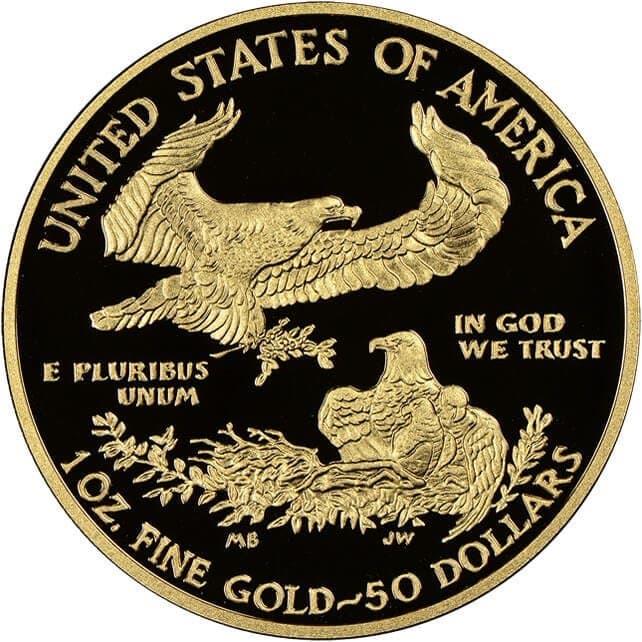
The Gold Bullion Act of 1985 not only authorized the creation of the Gold American Eagle but also set clear design requirements for the $50 coin. By law, the largest denomination must feature an image "symbolic of Liberty" on the obverse and a reverse design showing "a family of eagles, with the male carrying an olive branch while flying above a nest with a female eagle and hatchlings."
The coin must also include inscriptions of its $50 face value, gold content in troy ounces, the year of issue, and the traditional mottos associated with U.S. currency: "Liberty," "In God We Trust," "United States of America," and "E Pluribus Unum." In addition, each Gold American Eagle must be struck with reeded edges.
Obverse Design
Reverse Design
2021 Type 2
The obverse of the Gold American Eagle continues to feature Augustus Saint-Gaudens' iconic full-length portrayal of Lady Liberty, first introduced on the $20 Double Eagle in 1907. For the 2021 Type 2 release, the U.S. Mint enhanced this historic design by returning to Saint-Gaudens' original bronze casts and archival assets.
These refinements restored legacy details such as the Capitol building, stars, torch, sun rays, and other design elements, ensuring a closer reflection of the artist's vision. Notably, Liberty's eyes now appear more defined, the sun's rays have been reshaped, Saint-Gaudens' initials were reinstated, and the olive branch motif was refined. Additionally, the 2021 one-ounce Proof issue introduced a reeded-edge variation as an anti-counterfeiting measure.
New Reverse
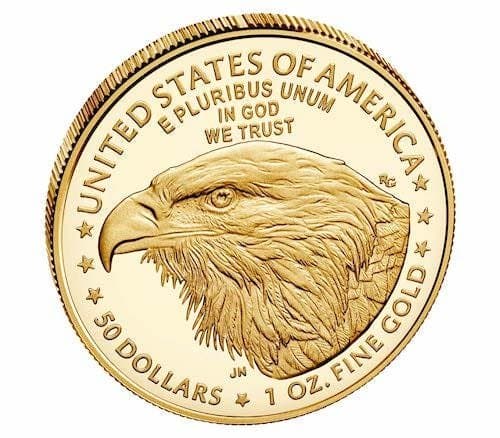
Since its debut in 1986, the Gold American Eagle Proof coin had always featured the "Family of Eagles" reverse, created by Miley Busiek Frost and sculpted by Sherl J. Winter. However, the 2021 Type 2 issue marked the program's first design transition in 35 years.
The new reverse design, created by Jennie Norris of the Mint's Artistic Infusion Program, presents a bold, close-up portrait of an American eagle. Inspired by her experience as a volunteer raptor handler, Norris sought to capture the intensity and nobility of the eagle's gaze. "The American Eagle is such a noble bird," Norris explained, "I wanted to reflect his pride and timeless wisdom through the closeness of his stare."
Unlike Busiek's narrative of a family of eagles in flight and in the nest, Norris's design focuses on stillness and presence. The eagle's penetrating gaze, paired with intricate lifelike details, gives the impression of a living, breathing creature.
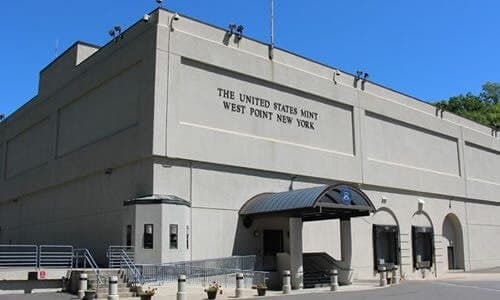
Today, all Proof Gold American Eagles are produced at the West Point Mint in West Point, New York—also the site of the U.S. Military Academy. The facility is responsible for striking every Proof and Uncirculated Bullion American Eagle in gold, silver, platinum, and palladium, as well as all gold commemorative coins and select silver commemoratives.
The West Point Mint was originally built in 1937, just four years after President Franklin D. Roosevelt ordered all privately owned gold to be surrendered to the U.S. government during the Great Depression. Initially established as a bullion depository, it specialized in storing silver and quickly earned the nickname "The Fort Knox of Silver."
Although the site did not gain official U.S. Mint status until 1988—two years after Gold American Eagles first entered circulation—the West Point facility was already producing U.S. coinage during its earlier years. In fact, coins bearing the "W" mint mark were struck as early as 1983, five years before West Point was formally recognized as an official branch of the Mint.
Get Started